Since ancient times people have tried to find ways to preserve and spread information. Archaeologists find various, not always understandable, drawings on the walls of ancient caves and on animal bones and tusks. Among them are images of animals, magical signs, plants, the sun and other objects of the surrounding world. Some of the oldest wall paintings were found in the Altamira cave in Spain. According to archaeologists, they were created between 13,000 and 10,000 BC. The Altamira paintings are about 15,500 years old. Ancient people depicted the lives of animals — bulls, horses, boars and bison — quite skilfully and colourfully. The images were painted in yellow, black and red. Primitive people kept their paints in seashells. Amazingly, the contemporaries of mammoths achieved a level of artistic skill that remained unattainable for many generations over thousands of years.
According to some sources, the first printed publication appeared in China back in 868 AD and was called the “Diamond Sutra”. The text was printed on long sheets of paper rolled into a scroll. The person writing the sutra applied wet ink to a wooden board, the board was carved, and the parts without characters were removed. Ink was then applied to the board and impressions were made.
The invention of papyrus
The next very important stage in the development of printing was the invention of papyrus. Papyrus is a material made from the papyrus plant (a marsh plant) that looks like paper. Strips of the plant’s pith are laid one on top of another, with the next layer placed crosswise. The sheet is then pressed again. Papyrus was first used during the reign of the first dynasty in ancient Egypt.
The next stage in the development of printing was applying images to specially prepared animal skins. It should be noted that before the invention of the printing press, books were copied by hand, mostly by monks in monasteries. It was very hard, painstaking work, so a single book could take years to write, sometimes even a lifetime.
Only in 1309 did paper appear in Europe. And by 1390 the first paper mill opened in Germany.
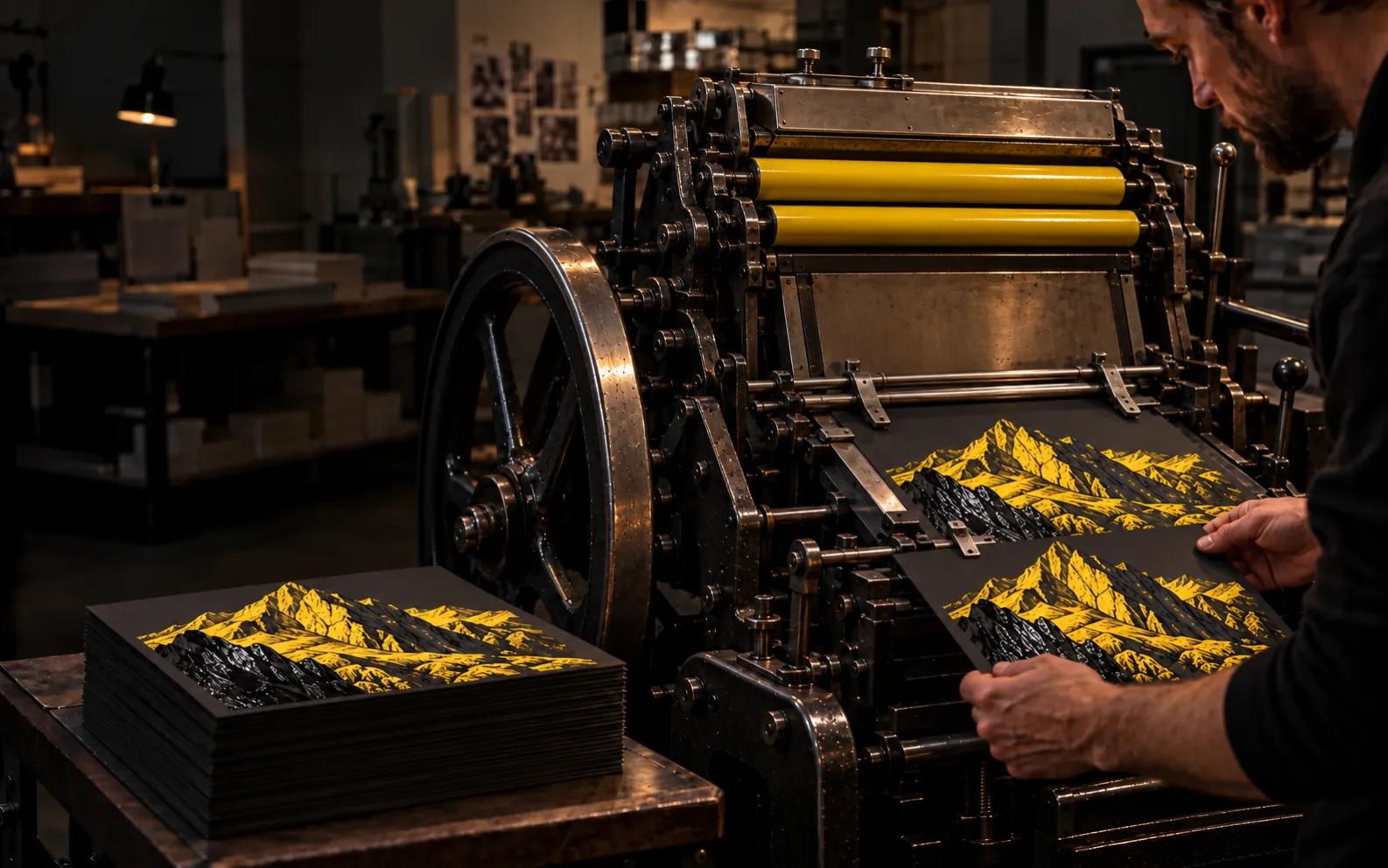
Around 1436 the German goldsmith and entrepreneur Johannes Gutenberg invented the printing press, which later became known as the “Gutenberg press”. The letters in this press were wooden (later metal), and any text could be typeset with them. A few years later Gutenberg improved his press: before pressing onto paper, the letters were inked with a roller. In the 1450s the inventor printed the first printed book on his press, known as the “Gutenberg Bible”. Using his press, Johannes printed about two hundred copies of the Bible and sold them at the Frankfurt Book Fair.
At the beginning of the 20th century three patents were granted, but only one of them led to the first offset press. A certain Caspar Hermann applied for a patent for a sheet-fed multicolour offset press. However, Hermann’s registration was refused on the grounds that similar equipment already existed. A year later, in 1904, Hermann, together with I. W. Rubel, registered a patent for the development and production of a multicolour offset press. Rubel noticed by chance that an impression transferred from a rubber blanket to paper was of better quality than one printed directly from the plate. However, he did not live to see his invention released. The first multicolour sheet-fed offset press was built in Germany under Hermann’s direction and was called “Triumph”. It printed 5,000 impressions per hour in a 60 × 40 cm format.
Today printing is done with modern offset and digital presses that deliver excellent quality at high speed. In most cases all processes are managed and controlled by computers. It is hard even to imagine what our modern society would look like if we took away the discoveries in printing, such as offset and digital printing, from its history.